
State of the Electronic Components Market: March 2026
Pricing Momentum Continues as the Market Finds Its Footing
Lytica is the world’s only provider of electronic component spend analytics and risk intelligence using real customer data. As a result of our unique position in the marketplace, we’ve been able to work with 100+ customers in analyzing over $550 billion in electronics spend. We curate up-to-date insights on the state of the electronic component market and share them here with you each month. Subscribe today to receive these each month upon release.
Lytica’s component basket comprises 165,000 electronic components across more than 30 categories, including the most popular devices used by our customers. These indices are intended to show market trends. Individual component and BOM analysis is offered by Lytica as a service to our customers.
From Repricing Shock to Structured Inflation
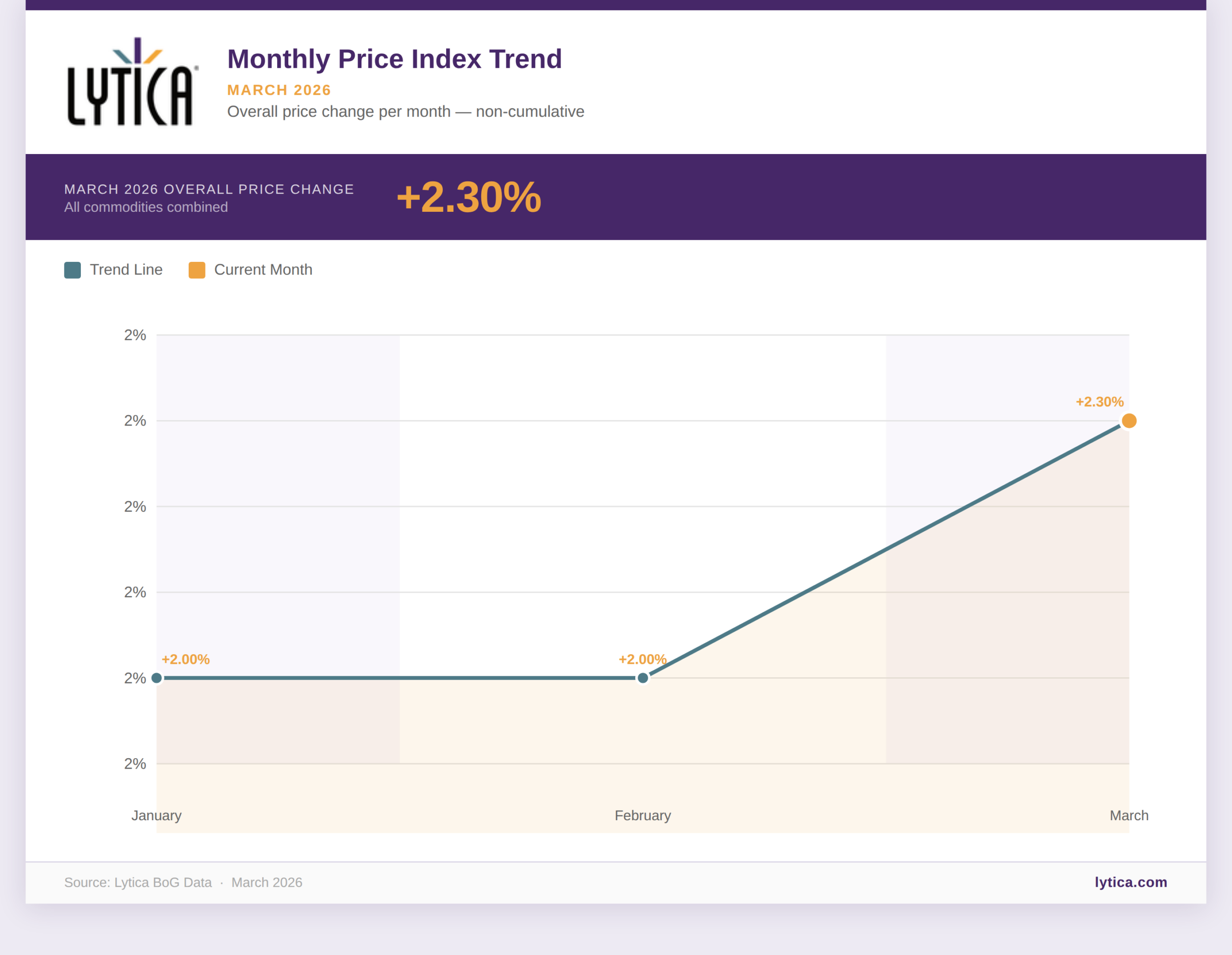
March’s overall price index came in at +2.30%, a modest step up from the +2.00% recorded in both January and February. The headline is small. The signal it carries is not.
For the first time in the current cycle, every single category in Lytica’s basket posted a price increase after February had only three decliners — Connector, Optomechanical, and Relay & I/O Module. In March, all three reversed direction. The market floor has firmed, and that matters.
The spread between the fastest and slowest movers narrowed too. In February, Memory’s +8.40% and Relay & I/O Module’s –1.00% sat 9.4 percentage points apart. In March, the distance between Memory at +7.60% and Display Assembly at +0.80% closed to 6.8 points. Still, the market is not uniform — AI-driven categories are inflating at a different pace than consumer-facing ones — although it is becoming more coherent.
The forces behind this are structural, not cyclical. AI and data center investment continues to pull hard on memory, processors, and power components. Foundry cost pass-throughs from late-2025 contract resets are still working through the system. Copper, lithium, and aluminum remain elevated. None of these pressures are easing.
There is also a risk on the horizon that did not yet show up in March pricing. The US-Israeli war against Iran began on February 28. Iran’s closure of the Strait of Hormuz, combined with strikes on Qatar’s Ras Laffan LNG facility on March 18 and 19, has put semiconductor-grade helium supply under serious threat. The full implications will be addressed in the April report (subscribe now to make sure you don’t miss it). Procurement teams should be thinking about it now.
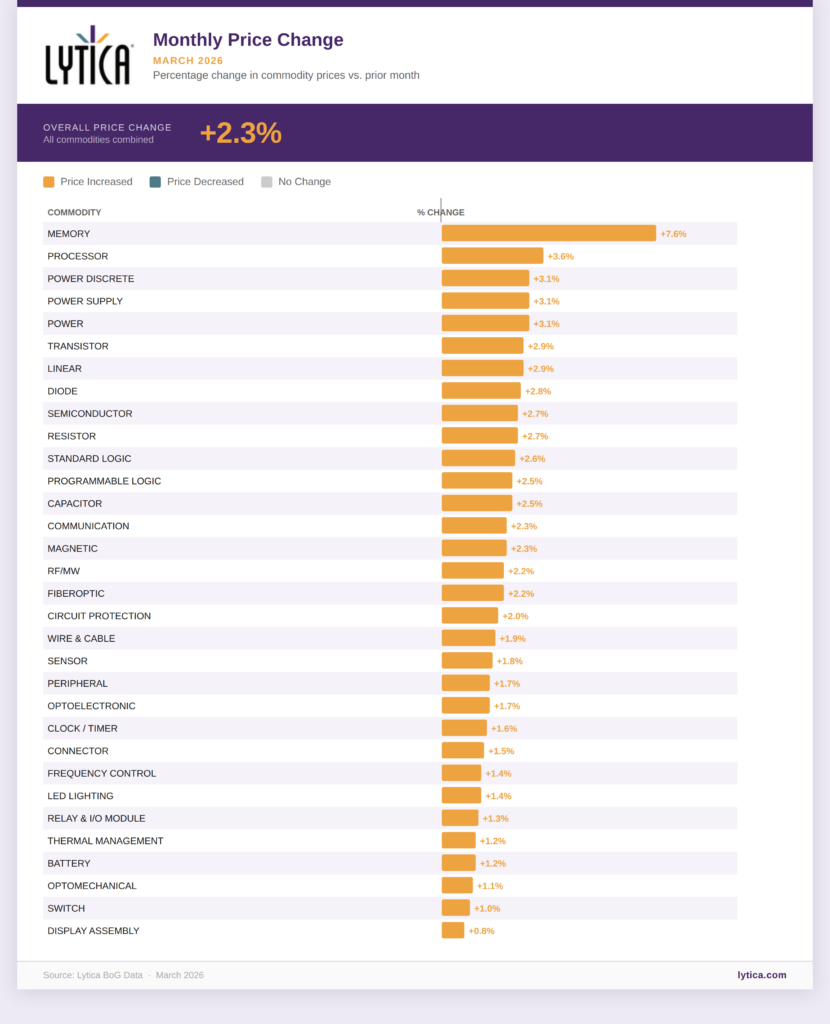
Monthly Price Change by Category
Memory (+7.60%)
Memory held its position as the basket’s dominant inflation driver for the third month running, though the rate of increase edged down from February’s +8.40%. Do not read that as relief. Manufacturers continue shifting capacity toward HBM and server DRAM, leaving standard memory increasingly undersupplied. TrendForce revised DRAM contract prices upward to +90–95% quarter-over-quarter, with NAND Flash expected to follow at +55–60%. The monthly deceleration reflects a maturing repricing wave, not a supply recovery. Teams with memory-heavy BOMs should be locking in forward contracts now.
Processor (+3.60%)
The second-largest mover in March isaccelerating. Hyperscalers continue to pull forward orders for data center and inference hardware, and there is no near-term demand signal pointing to moderation. With the global semiconductor industry on track for nearly $975 billion in 2026 sales, suppliers here have pricing power, and they know it.
Power Supply (+3.10%), Power Discrete (+3.10%), Power (+3.10%)
Three categories, one story: EV infrastructure, industrial automation, and AI data center power delivery are all pulling in the same direction. SiC and GaN devices remain the most acute pressure points. This is structural demand. It is not softening.
Transistor (+2.90%), Linear (+2.90%)
Foundry cost pass-throughs from TSMC’s late-2025 price increases of 3–10% on sub-5nm offerings continue working through the analog and mixed-signal landscape. Steady, expected, and not finished yet.
Diode (+2.80%), Resistor (+2.70%), Semiconductor (+2.70%)
The market’s reliable middle tier. Consistent increases grounded in steady end-market demand and upstream cost pressure. Wafer cost pass-throughs and Q2 supplier price adjustments are the primary drivers across this group.
Standard Logic (+2.60%), Programmable Logic (+2.50%), Capacitor (+2.50%)
Worth watching: Programmable Logic was February’s largest lead time mover at +38.68%. March’s +2.50% price increase may be the first sign of that lead time signal translating into price. It usually does.
Fiberoptic (+2.20%), RF/MW (+2.20%), Communication (+2.30%), Magnetic (+2.30%)
Infrastructure demand, including data center interconnect, 5G, grid buildout, is holding these categories firm. Copper above $12,900 per metric tonne is the common thread running through magnetics, wire and cable, and power supply.
Circuit Protection (+2.00%), Wire & Cable (+1.90%)
Both categories continue to reflect sustained copper cost pressure. This is three consistent months with no sign of abating.
Battery (+1.20%)
Lithium carbonate hit approximately $26,278 per metric tonne in Q1 2026 — nearly double year-earlier levels — and demand is not letting up. Grid-scale storage installations hit 106 GW in 2025, up 43% year-on-year, driven by data centre expansion and grid modernization, with 2026 forecast to reach 359 GWh. The +1.20% increase in Lytica’s basket looks modest against that backdrop. It is not the full story. Raw material costs at this level take time to fully pass through to finished component pricing, and that transmission is still underway. Expect further increases in the months ahead.
Connector (+1.50%), Relay & I/O Module (+1.30%)
Both reversed February price declines. The recovery in pricing is modest but lead times in both categories spiked dramatically in March, with Connector at +170.73% and Relay & I/O Module at +89.45%. If those extensions persist into April, price follow-through is the likely next step.
Display Assembly (+0.80%)
This is the basket’s weakest mover and the clearest illustration of what the two-speed market looks like in practice. Consumer electronics demand remains soft, panel pricing has stabilized, and there is no meaningful upward pull. While Memory is at +7.60%, Display Assembly moved to +0.80%. Same month, same index, but this shows a completely different cost experience depending on your BOM.
Monthly Price Index Trend
Overall Index: +2.00% in February — Unchanged from January The overall monthly price index held at 2.00% for the second month in a row. That looks stable, but the average is hiding a growing gap between categories. Memory rose 8.40% while Relay & I/O Module fell 1.00% — same month, same index, completely different cost experience depending on your BOM.
The stability of the overall index through both January and February suggests the market has settled into a pattern where AI-driven inflation in high-demand segments is being offset, in aggregate, by softer pricing in more commoditized categories. Whether this equilibrium holds into Q2 depends largely on the trajectory of memory pricing.
Lead times compressed significantly in February, with the overall lead time index falling to –3.53%—a sharp acceleration from January’s –0.90%. Most categories saw lead time reductions, with particularly notable improvements in Connector (–27.58%),
Monthly Lead Time Change
| Overall Index: +2.30% in March — Third consecutive month of increases |
| Three consecutive months of increases in the 2.00–2.30% range represent consistency. The market is no longer whipsawing between sharp moves. For the first time this cycle, every category in the basket moved in the same direction. The key question entering Q2 is whether the weight of memory and processor pricing will push the overall index meaningfully higher, or whether stabilization in some categories will keep the headline contained. With Q2 supplier price increases already announced across multiple semiconductor families, upward pressure is more likely than not. |
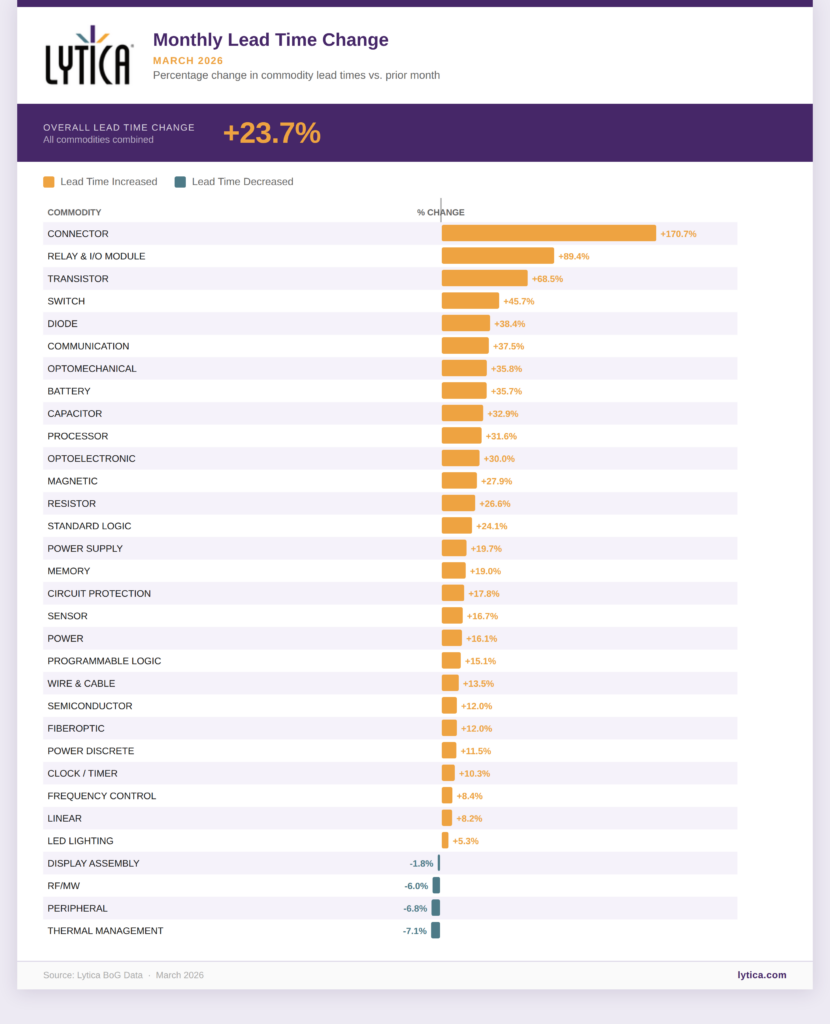
Monthly Lead Time Change
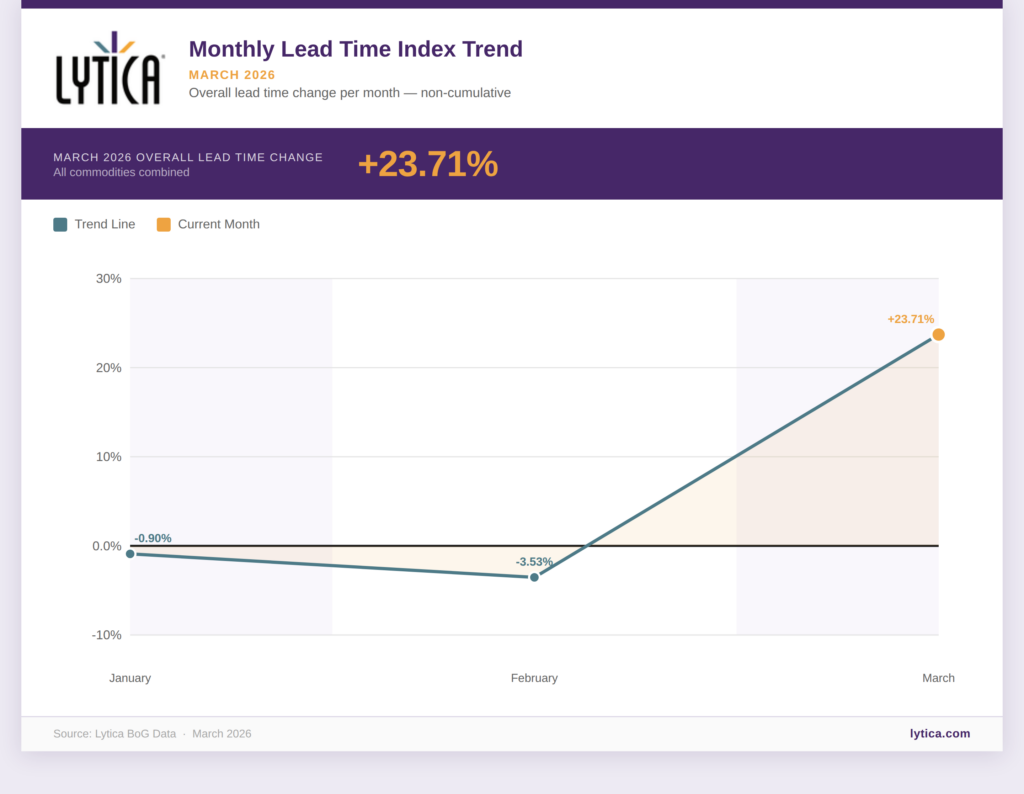
March saw a dramatic reversal in lead time trends, with the overall lead time index surging +23.71% — a sharp swing from February’s –3.53% compression and January’s –0.90% decline. This is the largest monthly lead time increase recorded in the 2026 dataset to date and requires careful interpretation.
The headline number is heavily skewed by a small number of extreme movers. Connector posted the largest single-category increase at +170.73%, followed by Relay & I/O Module at +89.45%, Transistor at +68.46%, Switch at +45.67%, and Diode at +38.42%. These were among the largest decliners in February — Connector had fallen –27.58%, Switch –24.50%, and Relay & I/O Module –15.99%.
The March spike in these categories is consistent with a demand rebound following February’s inventory drawdown, likely amplified by procurement teams pulling forward orders ahead of anticipated Q2 price increases.
Four categories posted lead time decreases in March: Thermal Management (–7.15%), RF/MW (–6.02%), Peripheral (–6.83%), and Display Assembly (–1.83%) — all categories where demand is softer or supply chains have normalized.
Lead Time Index Trend
| Lead Time Index: +23.71% in March — Sharp reversal from February’s –3.53% |
| The swing from compression (where lead times shorten and supply loosens) to extension (where lead times lengthen and supply tightens) in a single month reinforces that lead time data must be read in context. February’s broad compression was a genuine positive signal. March’s spike is concentrated in categories that had the most acute February compressions. The pattern is consistent with short-cycle inventory dynamics and procurement front-loading rather than structural supply deterioration, but the lead time extensions in Connector, Relay & I/O Module, and Transistor should be monitored over the next 30–60 days. If they persist, pricing follow-through in these categories is likely. |
Stock Availability
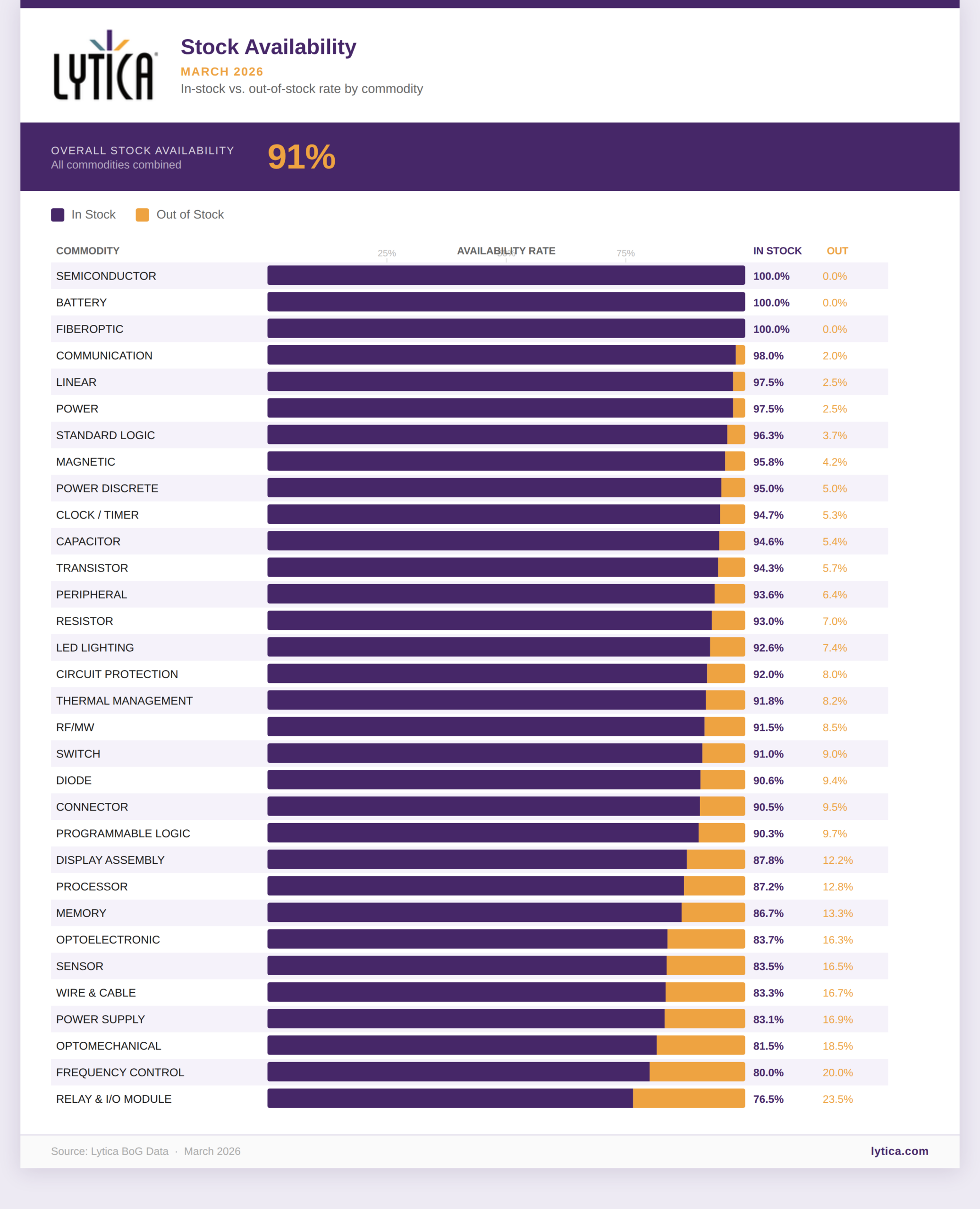
Overall stock availability held at 91% in March, unchanged from February, indicating that the broad supply picture remains healthy. Three categories — Semiconductor, Battery, and Fiberoptic — reached 100% availability, while the vast majority of categories tracked above 90%.
Memory availability at 86.70% remains below the basket average despite continued price increases — reinforcing the interpretation that memory pricing is driven by supplier repricing and capacity reallocation toward HBM and server DRAM rather than outright shortages at current demand levels. Frequency Control at 80.00% and Relay & I/O Module at 76.53% represent the tightest availability in the basket, the latter consistent with the sharp lead time extension recorded this month.
The overall picture — 91% across the basket with no categories in acute shortage — continues to support the interpretation established in February: this is a cost-driven inflation cycle, not a shortage-driven one. Prices are rising because suppliers can raise them, and the supply chain is broadly functioning. That assessment was accurate for March. Whether it remains accurate for April depends in large part on how the Gulf situation develops, and that will be the central question in next month’s report.
Looking Ahead
Key takeaways for procurement teams
The March data provides a clean, well-understood baseline. Every category is positive. The overall index is at +2.30%. Lead times are volatile but explainable. Availability is stable at 91%. This is the last month for which a relatively straightforward structural narrative holds.
April will introduce a new variable that March data does not yet capture. The Strait of Hormuz closure and the damage to Qatar’s Ras Laffan LNG facility — the world’s largest source of semiconductor-grade helium — occurred in March but had not yet been reflected in component contract pricing when the March data was collected. The helium supply runway for Asian fabs extends by approximately six weeks from the point at which existing shipments are exhausted, placing the first potential fab-level constraints squarely in the April timeframe. The April report will address this in full. (Subscribe now so you don’t miss it!)
For procurement teams, the specific categories to monitor between now and the April report are: Memory and High Bandwidth Memory (most exposed to helium-driven fab output constraints), advanced logic and processors (same exposure, slightly longer contract lag), and Wire & Cable, Magnetics, and Connectors (exposed to the secondary effects of aluminum and copper cost increases flowing from the Gulf energy disruption). The 2.30% March index should not be used as a forward planning assumption. The April number may look quite different.
Sources and References
The following sources were consulted in preparing this report to provide broader market context, pricing data, and geopolitical analysis, alongside Lytica’s proprietary component basket data. for more on the electronic components market.
Bloomberg, “Iran Strike Damages 17% of Qatar LNG for 3–5 Years,” March 19, 2026. https://www.bloomberg.com/news/articles/2026-03-19/iran-strike-damages-17-of-qatar-lng-for-3-5-years-reuters-says
Bloomberg, “Iran Strike Damages 17% of Qatar LNG for 3–5 Years,” March 19, 2026. https://www.bloomberg.com/news/articles/2026-03-19/iran-strike-damages-17-of-qatar-lng-for-3-5-years-reuters-says
Carbon Credits, “Lithium Prices Climb Again in 2026,” March 2026. https://carboncredits.com/lithium-prices-climb-again-in-2026-sending-stocks-skyward-nili/
CBS News, “It’s not just oil — the Iran war is disrupting helium and aluminum supplies,” March 2026 https://www.cbsnews.com/news/iran-war-helium-aluminum-shortage-impact/
CNBC, “QatarEnergy halts LNG production after Iran drone attacks,” March 2, 2026.https://www.cnbc.com/2026/03/02/qatars-state-owned-energy-company-halts-lng-production-after-iran-drone-attacks.html
CNBC, “Iran missile attack causes extensive damage to Qatar’s Ras Laffan facility,” March 18, 2026.https://www.cnbc.com/2026/03/18/iran-war-qatar-ras-laffan-natural-gas-lng.html
Counterpoint Research, “Memory Prices Surge Up to 90% From Q4 2025,” February 5, 2026.https://counterpointresearch.com/en/insights/Memory-Prices-Surge-Up-to-90-From-Q4-2025
Credendo, “Lithium, Cobalt, Nickel and Copper Market Update,” February 12, 2026.https://credendo.com/en/knowledge-hub/lithium-cobalt-nickel-and-copper-market-update-volatility-supply-risks-and-diverging
Deloitte Insights, “2026 Semiconductor Industry Outlook,” February 11, 2026.https://www.deloitte.com/us/en/insights/industry/technology/technology-media-telecom-outlooks/semiconductor-industry-outlook.html
Digitimes, “Strait of Hormuz disruption puts semiconductor supply chains at risk as photoresist shortages grow,” March 2026.https://www.digitimes.com/news/a20260424VL214/euv-photoresist-materials-middle-east-disruption-2026.html
Forex.com, “Trade to watch 2026: Copper’s time to shine?,” February 3, 2026.https://www.forex.com/en-us/news-and-analysis/trade-to-watch-2026-copper-s-time-to-shine/
J2 Sourcing, “The Global Helium Crisis: What It Means for Semiconductor Manufacturing and Electronic Component Supply Chains,” March 2026.https://j2sourcing.com/blog/helium-crisis-semiconductor-manufacturing-electronic-components-2026/
Omdia / Informa TechTarget, “SemiDynamics 2026 Q1 Report,” March 2026.https://omdia.tech.informa.com/
Reuters, “Helium Shortage Has Started Impacting Tech Supply Chains, Execs Say,” March 26, 2026.https://money.usnews.com/investing/news/articles/2026-03-26/helium-shortage-has-started-impacting-tech-supply-chains-execs-say
SoftwareSeni, “DRAM Prices in 2026 Have Doubled,” March 2026.https://www.softwareseni.com/dram-prices-in-2026-have-doubled-and-the-numbers-are-getting-worse/
Sourceability, “2026 Semiconductor Industry Outlook + M&A,” 2026.https://sourceability.com/post/semiconductor-industry-outlook-for-2026-shows-rebound-amid-mergers
Sourceability, “Tracking Memory Price Increases Across the Last Several Quarters,” March 2026.https://sourceability.com/post/tracking-memory-price-increases-across-the-last-several-quarters
StartUs Insights, “Semiconductor Industry Outlook 2026: Snapshot,” February 9, 2026.https://www.startus-insights.com/innovators-guide/semiconductor-industry-outlook-key-insights/
TechInsights, “McClean Report February 2026: Q1 Semiconductor Market Forecast Update,” February 2026.https://www.techinsights.com/blog/mcclean-report-february-2026-q1-semiconductor-market-forecast-update
Tom’s Hardware, “The global helium shortage is a direct threat to the chipmaking supply chain,” March 2026.https://www.tomshardware.com/tech-industry/semiconductors/the-global-helium-shortage-is-a-direct-threat-to-chipmaking
Trading Economics, “Copper — Price — Chart — Historical Data,” February 2026 https://tradingeconomics.com/commodity/copper
TrendForce, “Memory Price Outlook for 1Q26 Sharply Upgraded,” February 2, 2026.https://www.trendforce.com/presscenter/news/20260202-12911.html
WCCFTech, “Memory & NAND Prices Surged Over 90% In Q1 2026,” February 9, 2026.https://wccftech.com/memory-nand-prices-surged-90-percent-in-q1-2026/
Wood Mackenzie, “Global energy storage market surpasses 100 GW annual installation milestone in 2025,” January 2026.https://www.woodmac.com/news/opinion/global-energy-storage-market-surpasses-100-gw-annual-installation-milestone-in-2025/
To receive the Monthly State of the Market Report directly to your inbox subscribe here.